Every real-world vision system eventually meets the same obstacle: data. Not just the amount, but the kind that truly reflects the long tail: rare, messy, and unpredictable cases that determine whether a model works outside the lab. Capturing and labeling enough of these examples is slow, expensive, and often impractical. Teams spend most of their time managing data pipelines instead of improving models. Once the data barrier is lifted, model building becomes a structured process. With reliable and representative data, AI agents can handle much of the training and evaluation loop automatically, testing hypotheses faster than any manual cycle could.
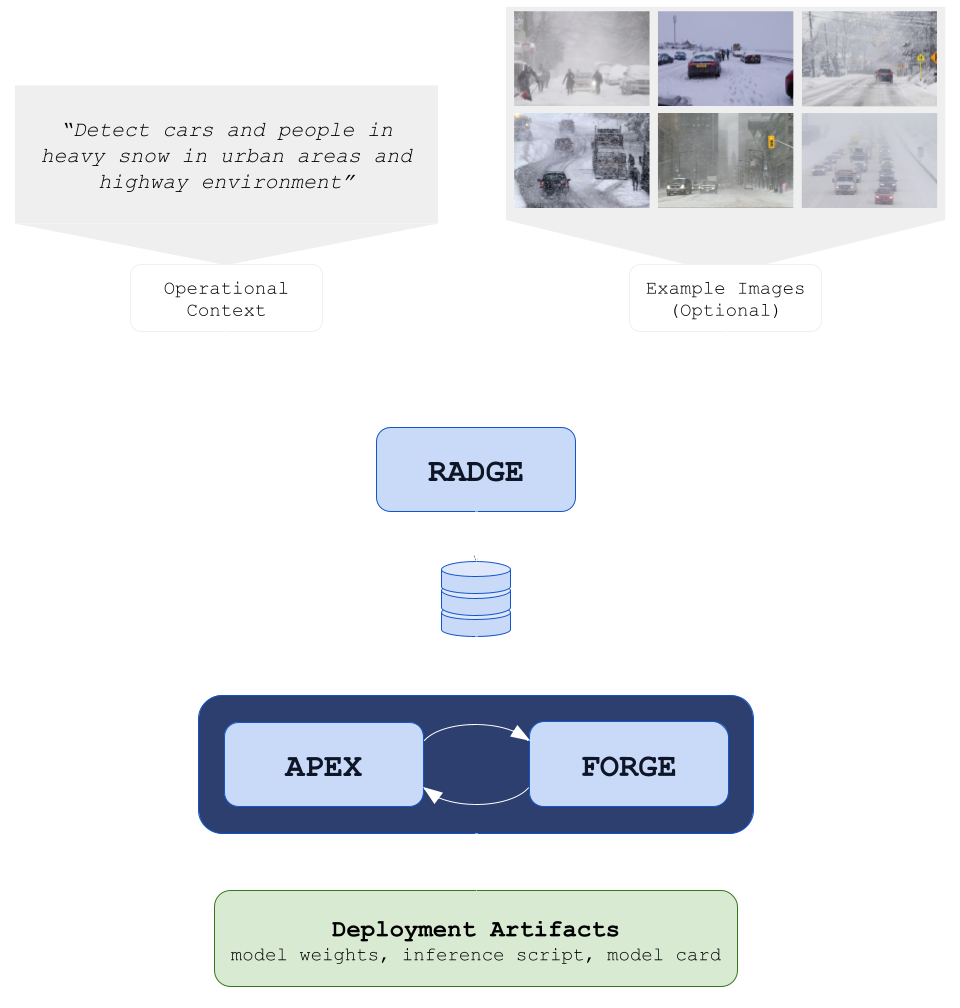
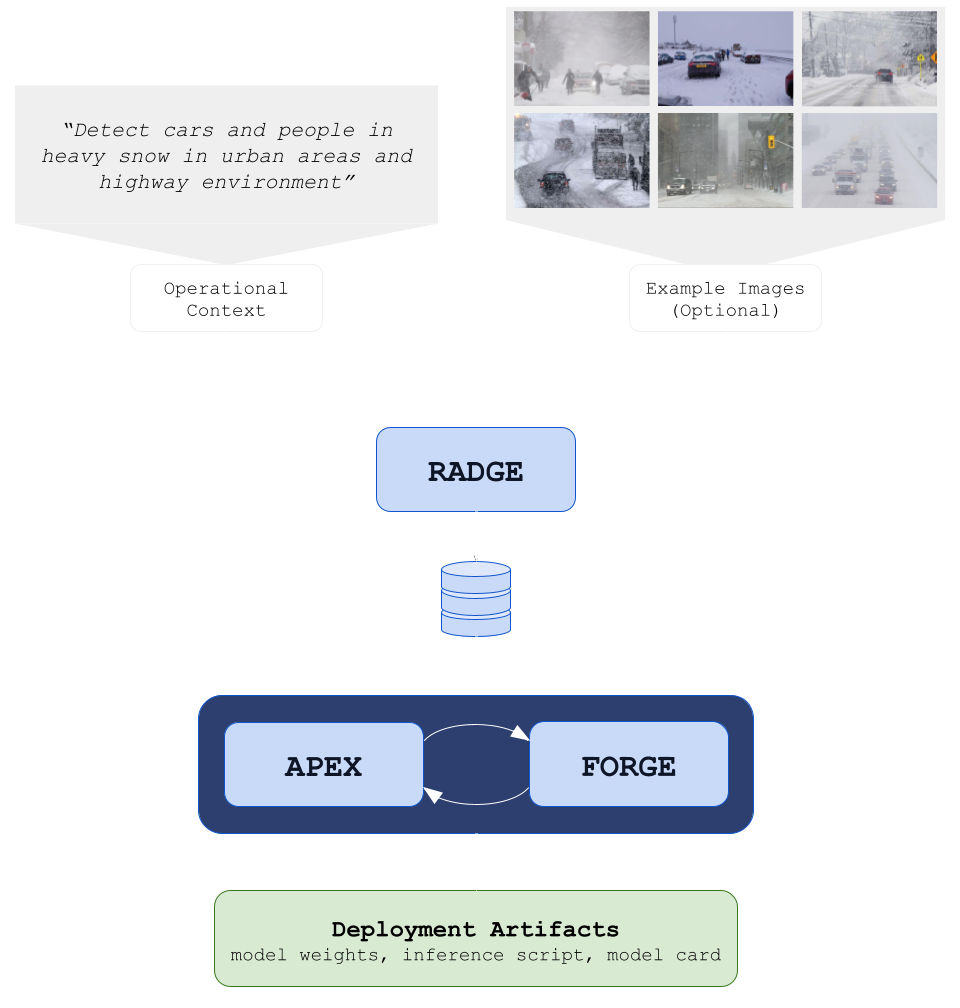
Yrikka’s Text-to-Model (T2M) is built around this idea. Starting from a few unlabeled images and a natural-language description, T2M generates the data, trains multiple candidate models, and evaluates them under realistic conditions. It runs on the three steps of ORION, Yrikka’s vision AI lifecycle platform: ORION Data generates realistic, labeled data that covers the long tail; ORION Test runs scenario-matched evaluation and red-teaming; and ORION Adapt, an agentic training system, coordinates fine-tuning and model selection, completing the loop from concept to deployment.
1. Why data is the bottleneck
ML teams consistently report that data collection and labeling dominate project time and budget. Surveys often find that roughly 80% of ML development effort goes into data work before modeling even begins. Data‑centric AI reframed progress around systematic improvements in datasets and label quality rather than endless architecture tweaks. In particular, small upstream data issues compound downstream into reliability failures [1].
Collecting representative data is expensive. It must span weather, time of day, motion blur, and long‑tail events. In safety‑critical domains (e.g., AV, autonomous drones), capturing edge cases is costly, risky, and statistically intractable: demonstrating safety through public‑road testing alone would require hundreds of millions to billions of miles, and real‑world testing “places the public in danger,” making advanced simulation essential [2]. Even when data is available, labeling costs stack up quickly. Typical pricing for annotation range from $0.02–$1.00 per bounding box and $0.05–$3.00 per mask, with specialized annotations much higher for complex tasks; at the frontier, single expert annotations can cost tens of dollars or more.
2. Synthetic data is necessary but realism matters
Traditional simulation and game‑engine pipelines often suffer a sim‑to‑real gap: models that excel on synthetic data underperform on real imagery without extensive manual tuning. Closing this gap typically requires deep domain expertise and significant effort. [3]
Diffusion models challenge this paradigm. They produce highly realistic samples and can be steered by text, layout, or segmentation conditioning. For example, the FLUX family and its variants demonstrate strong photo‑realism and fast generation at high resolution [4]. Multiple studies show diffusion‑generated data can improve object detection and segmentation performance, especially in low‑data or long‑tail regimes [5]. But realism alone isn’t enough. How do we ensure the images cover the long tail, match our sensors, and arrive with trustworthy labels?
3. Prompt‑to‑Data: ORION Data
ORION Data, ORION’s retrieval-augmented data generation step, learns your domain from a few example images and a brief natural‑language spec.
- Contextual alignment. A structured scene graph is compiled from the prompt (weather, lighting, occlusion, backgrounds, distractors), and augmented with object taxonomies and explicit negative classes.
- PEFT adapters. Using parameter-efficient fine-tuning (PEFT) on ~10–50 examples, ORION Data personalizes the generator to distinctive objects, liveries, textures, and camera noise profiles.
- Auto-annotation. ORION Data generates controllable layouts (boxes, masks, phrases) and attaches labels at generation‑time, then applies post‑filters that discard inconsistent instances or out‑of‑scope scenes.
The output is scalable, labeled multi-modal (e.g., EO/IR) data matched to your optics and environment.
4. Data-to-Model: ORION Adapt
With ORION Data producing sensor-matched, labeled data on demand, the bottleneck shifts from data collection and processing to model iteration. These model iterations can be automated with AI agents. ML engineer (MLE) agents are increasingly capable of executing well-structured ML engineering tasks autonomously. Results from OpenAI’s MLE-Bench show that such agents can achieve top 10% performance among ML teams on Kaggle-style tasks [6].
Yrikka’s Text-to-Model framework treats model training as an engineering loop: propose, run, measure, and iterate. That loop runs in ORION Adapt, ORION’s agentic fine-tuning step. Its multi-agent framework launches candidate model backbones (e.g., YOLOv11, DETR, Faster R-CNN), tunes hyperparameters, blends synthetic with any real data you provide, and evaluates every candidate in a closed loop. ORION Test, ORION’s evaluation step (also available programmatically through the APEX API), automates model evaluation & red-teaming [7], enabling optimization against scenario‑matched metrics rather than global averages.
5. Operational impact
With data generation and training automated end-to-end, here’s what that translates to for your team:
- Scenario-matched data on demand. Synthetic multi-modal datasets tailored to your optics, environments, and long-tail edge cases that are already labeled and filtered.
- Candidate models, ranked for your use case. Multiple models trained on synthetic (and real data if available), and ranked based on condition-matched benchmarks.
- Trustworthy evaluation and governance. Metrics and red-teaming results from ORION Test, plus a clear model card (data blend, assumptions, known failure modes).
- Integration-ready artifacts. Weights, an inference script, and a brief report; streamlining model deployment for edge devices or cloud environments.
- Time and cost compression. Iteration cycles drop from weeks to minutes.
6. How it works
- Specification. The user provides a natural-language task description, e.g., “Detect cars and people in heavy snow in urban areas and highway environment”, and, optionally, a few reference images.
- Domain adaptation. The framework calibrates to the user’s optics, sensor characteristics, textures, and operating conditions.
- Programmatic coverage and labeling. Diverse scenarios including long-tail conditions are synthesized and labeled at generation time. The generated data is filtered to exclude low-quality or out-of-scope samples.
- Candidate training and tuning. Multiple model families are trained and tuned against user-specified constraints (e.g., accuracy, latency, model size, SWaP).
7. Case study
Adverse weather remains one of the most persistent challenges in autonomous perception. Snow, fog, and rain degrade visibility, distort textures, and confuse models trained predominantly on clear-day imagery. These conditions account for a significant portion of real-world failures in automated driving systems (ADS) and autonomous vehicles (AVs). Yet collecting such data is logistically demanding. It often requires travel to specific regions or seasons, specialized sensors, and safety-constrained operations in difficult conditions.
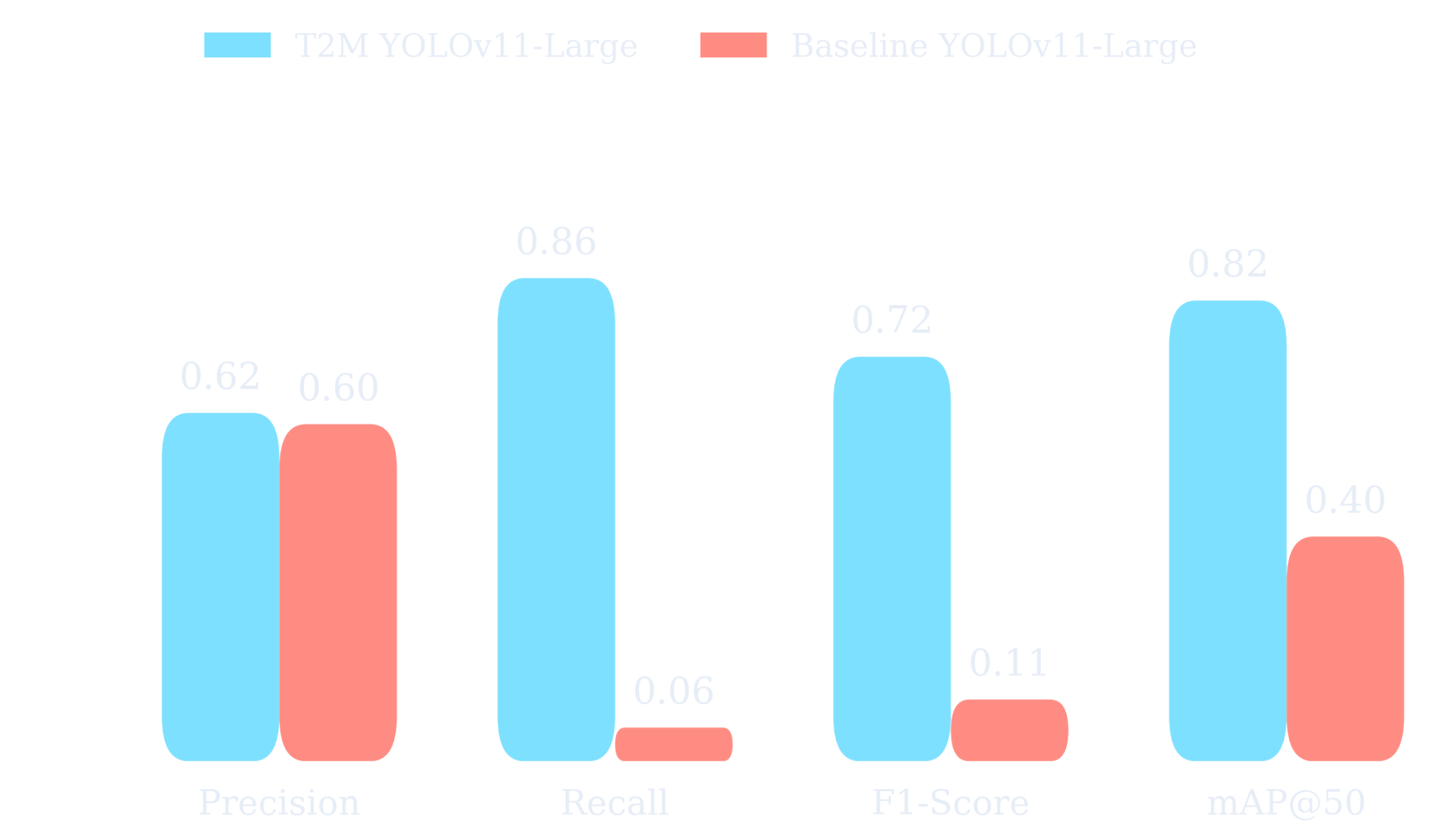
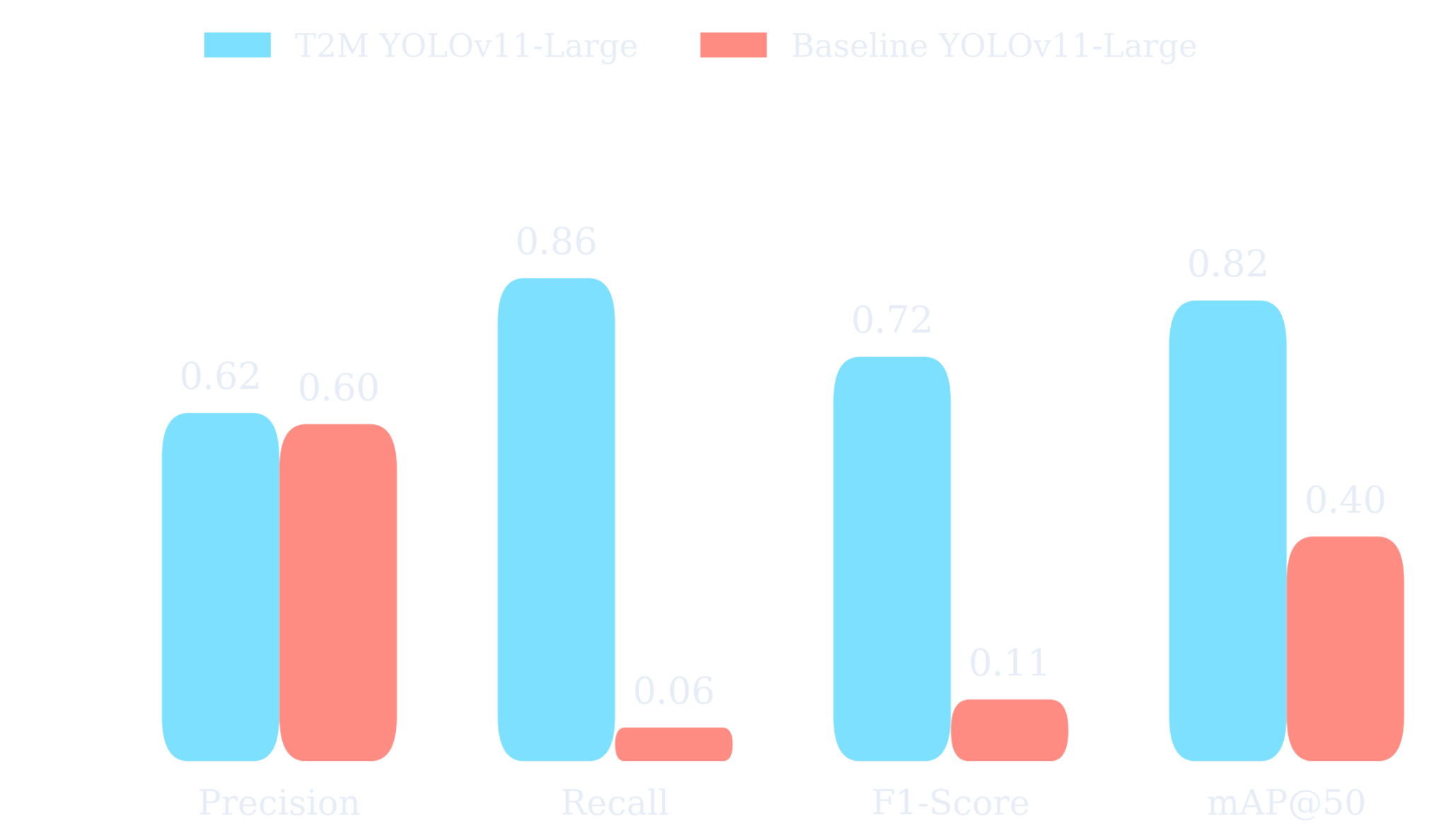
To explore how Text-to-Model (T2M) can address this gap, we applied it to detection of people and cars in heavy snow. Starting from a handful of unlabeled reference images and a brief textual description of the scenario, T2M generated sensor-matched synthetic data, trained multiple model candidates, and automatically selected the best performer for deployment. We then evaluated the resulting model on DAWN, a public benchmark of 1,000 real‑world traffic images captured in fog, snow, rain, and sandstorms, annotated with bounding boxes for the car and the person class across varied road scenes (urban, highway, freeway).
For this experiment, T2M selected YOLOv11-Large as the optimal architecture for the task. As shown below, the fine-tuned model substantially improved recall and mean average precision (mAP@50) under snow conditions compared to its pretrained counterpart. These results illustrate how domain-matched synthetic data and agentic fine-tuning can improve detection in the snow conditions studied here.
8. Limitations and risk
- Residual domain shift. Even with adaptation, rapidly changing backgrounds or rare specular highlights can degrade performance. For such settings, expanding adaptation with additional examples and performing periodic re-runs targeting newly observed conditions can mitigate this risk.
- Open‑set hazards. Under-specified negative classes (e.g., kayaks vs. jet skis) can increase false positives. Explicitly enumerating negative classes in the prompt and inclusion of negative sampling during generation and evaluation alleviate this failure mode.
- Label noise in auto‑annotations. A small rate of mis‑boxes or masks is inevitable despite data filtering. The training recipe compensates for this issue via robust losses and instance filtering.
- Ethics and privacy. Synthetic replicas of real places and people must respect privacy and local laws. Synthetic data generation should be treated as part of a responsible‑AI pipeline, not a bypass.
9. Conclusion
Building vision systems that hold up in the real world has always hinged on two things: having the right data and moving fast enough to use it effectively. Yrikka’s Text-to-Model brings those pieces together on ORION. ORION Data removes the data bottleneck by producing realistic, labeled samples matched to the user’s domain. ORION Test ensures models are tested under meaningful, condition-matched scenarios. And ORION Adapt closes the loop, coordinating the training, fine-tuning, and selection of models through an adaptive agentic framework.
Together, they form a unified workflow where data, modeling, and evaluation inform one another in real time. The result is not a shortcut, but a more direct path from concept to a dependable, deployment-ready model.
References:
[1] Sambasivan, Nithya, et al. "“Everyone wants to do the model work, not the data work”: Data Cascades in High-Stakes AI." Proceedings of the 2021 CHI Conference on Human Factors in Computing Systems. 2021.
[2] Kalra, Nidhi, and Susan M. Paddock. "Driving to safety: How many miles of driving would it take to demonstrate autonomous vehicle reliability?." Transportation research part A: policy and practice 94 (2016): 182-193.
[3] Sudhakar, Sruthi, et al. "Exploring the sim2real gap using digital twins." Proceedings of the IEEE/CVF International Conference on Computer Vision. 2023.
[4] Photorealism in AI: FLUX.1 Krea vs Dev
[5] Fang, Haoyang, et al. "Data augmentation for object detection via controllable diffusion models." Proceedings of the IEEE/CVF winter conference on applications of computer vision. 2024.
[6] Chan, Jun Shern, et al. "Mle-bench: Evaluating machine learning agents on machine learning engineering." arXiv preprint arXiv:2410.07095 (2024).